How Ultra-Indie Designers Do Paris Men’s Fashion Week
Far removed from all the big-money, conglomerate-backed spectacle, another Paris Fashion Week is quietly unfolding, led by a very different cohort of brands and designers. Call them independent, niche, or simply good, together, they represent a subtle but undeniable menswear superpower. They run tiny teams and tight collections. They know everyone they work with, from buyer to manufacturer. They are obsessed with fabrics. They don’t do marketing. They are not into making or selling as many clothes as possible. And nearly none of appear on the official calendar. Still, every January and June, they fly in from all over the world to present their latest collections during Paris Market Week in appointment-only showrooms.
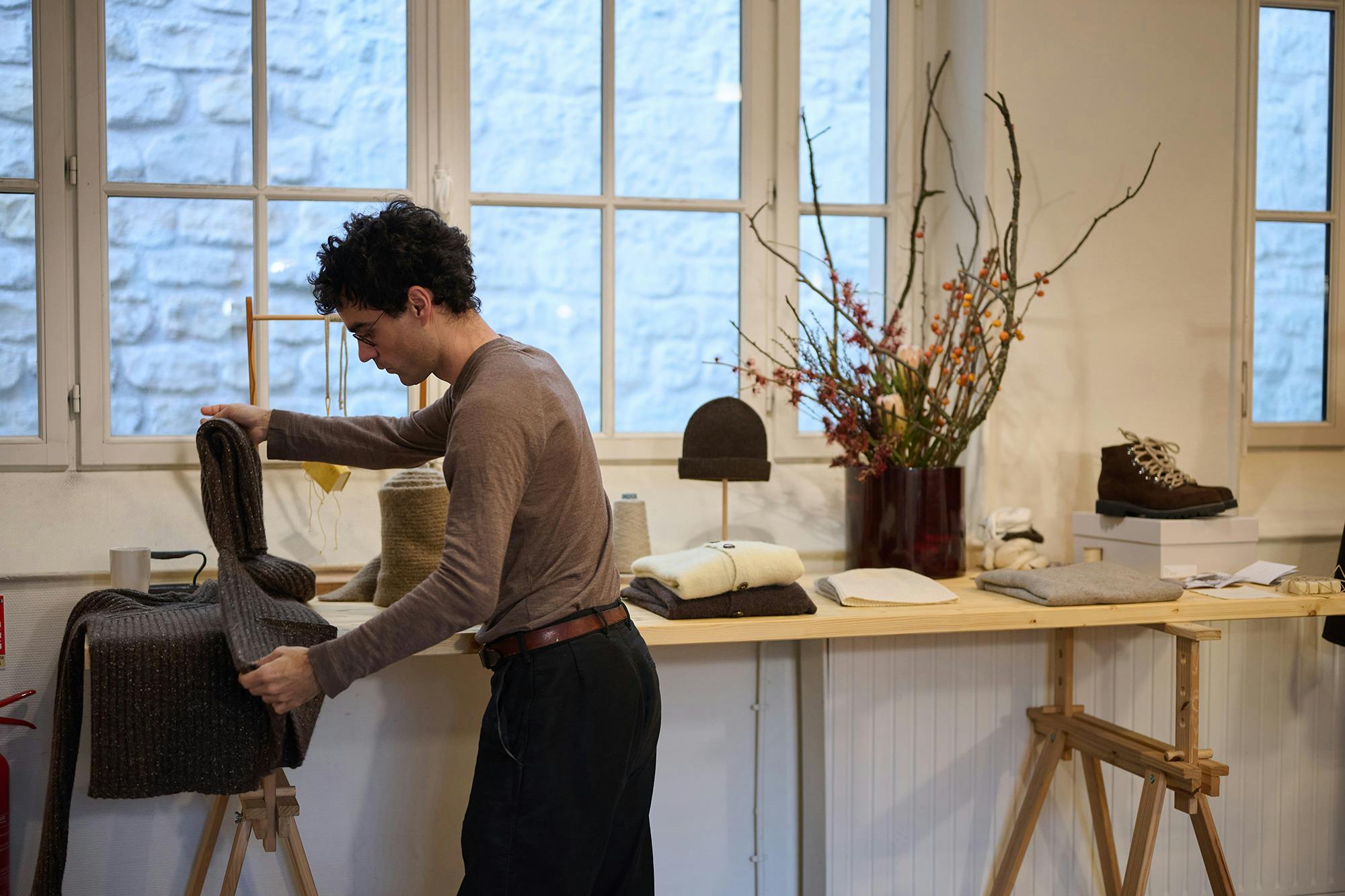
If these brands are like a whisper against the commercial roar of Fashion Week, there somehow exists an even softer hum underneath. This is the truly underground tier of emerging designers: no agency, no showroom, and often holding a full-time job on the side. For three days, I zigzagged across town to find these microbrands — fashion week’s outsider-outsiders, if you will — in back alleys, courtyards, and on upper floors. Some showed their work in the cheapest Airbnb they could find, or turned their ateliers into makeshift showrooms. Others traveled to Paris with nothing but a bag of samples. The six designers I spoke with represent just a fraction of this movement, but they perfectly capture its spirit: clothes created simply for the love of it. This is fashion at its most human scale.
My first stop on Thursday was with Colorado-based designer Fielding Miller. After years designing for synthetic textile giant Polartec, he launched his own brand, Thurston, in 2025. Since then, his performance-oriented headwear has been making waves, stocked by forward-thinking boutiques and outerwear stores alike, including New York’s Ven. Space and Aspen’s Performance Ski. This is his first time showing in Paris. “Things have been moving so fast, and I just felt I needed to be here, to catch up with friends and meet new people,” Miller says. The space — a 20-square-meter white Airbnb — contains little more than a kitchenette, a table, and a mirror. On the table, Miller has laid out around 20 quirky high-pile fleece and technical wool beanies, hats, and balaclavas in new colors and fabrics. That’s it. So far, he’s happy with the response. “I’m so grateful people are showing up. Along with the product, they are the whole point,” he says.
Later in the afternoon, after a quick lunch, I was welcomed by Cole Star of CSiLLAG (pronounced ‘Chill-äh-g’, meaning ‘star’ in Hungarian, his grandfather’s tongue). Based in New York, Star earned his stripes working with Martin Greenfield — a legendary Brooklyn tailor who crafted suits for presidents and movie stars — Emily Bode, and Enfants Riches Déprimés. Star, soft-voiced and wearing an outfit that gives vintage Armani vibes, launched CSiLLAG in 2015. “Paris has been a long time coming for me. When I started the label, it was more like a hobby, just making one-offs for myself,” he says. “Now I’m trying to get into stores, so coming here felt like a natural next step.”

Star showed his small collection of about a dozen items in the apartment of a retired antiques dealer filled with old objects, art books, family photos, and exposed wood beams. It feels like a natural habitat for Star’s midcentury-inspired informal tailoring, including Japanese-corduroy wide-leg trousers and Italian-fabric dress shirts hung on a coat rack that was already there. When asked whether the landlord was okay with him turning the place into a showroom, Star replies: “If I had ten appointments every day, the neighbors would probably start complaining. But I’m so small, that won’t happen. And, honestly, I had to take the risk — this is just what I can afford right now.”
Next, I met Clément and Germaine Douillet, brothers and founders of Maison Douillet, a French Alps-based brand specializing in luxury outdoor wear and everyday objects. Last season, they showed at a multi-brand showroom located in a neoclassical building on the fancy Place Vendôme. Not entirely happy with that crowded setting, this time they decided to turn their studio — part of a two-year residency hosted by the city of Paris — into an improvised showroom.

We were a little rushed due to a last-minute buyer’s appointment they couldn’t turn down. Luckily, they still found time to walk me through the collection while the other creatives in the mezzanine eavesdropped. All their cushy clothes, from hand-quilted puffers to chunky knit cardigans, are made in France from mostly natural materials sourced domestically, including linen, silk, hemp, and merino wool.
London brand Conkers follows a similar place-based, fabric-first ethos and is as quietly radical in its commitment. Romina Ferrari, one half of Conkers, greeted me at the door, and her partner Oliver Warner offered a glass of West Sussex cider. Although it’s someone else’s apartment, entering the space — on a busy street in the Montmartre with the beautiful name La Rue de la Goutte d’Or — feels like entering their home.

This feeling of personal intimacy ties in with the message of the new collection, titled “Local.” “Everything we do is about supporting people we can sit down with over tea, whether at factories, mills, or leather workshops,” Warner says. That approach, combined with a British countryside-pub aesthetic, results in UK-made wool gardening blazers, linen farmer shirts, and shearling hats now sold everywhere from Rising Star Laundry in San Francisco to Maidens Shop in Tokyo.
Speaking of Maidens, it was the store’s head buyer, Shinya Makino, who introduced me to my last two Paris appointments: Eiichi Suzuki from Atelier Gorsch and Hiroyuki Kato from Senui, a brand that only makes shirts. Both traveled to Paris without a showroom, so we met in the back room of a coffee shop where they showed me samples of their work, worn by themselves and carried in shopping bags. Kato works at FilMelange, the knit-focused brand where Ryoto Iwai, famous founder of AURALEE, used to be the designer. “Senui is a purely personal project,” Kato says. “Because of my role at FilMelange, I can do it completely in my own way, focusing on fabrics and details rather than growth and profit.” This creative freedom results in artisanal shirts, hand-cut and hand-sewn in his workshop in Tokyo.


Suzuki’s story is different — and quite unbelievable. Trained as a diplomat, he worked for several years at the Japanese embassies in Mexico and Bolivia. “My work got so boring, I knew I had to do something. One day, I was walking the streets of La Paz, passed a tailor, and decided to go inside. I said, ‘Please tell me how to make clothing,’ and they said, ‘Okay.’” For the next two years, he visited the tailor on weekends to take free lessons, starting from scratch. Not long after, Suzuki quit his job and applied to Central Saint Martins. He didn’t like it there either so he moved to Berlin to gain hands-on experience working for Frank Leder. After three years, he moved back to Japan’s rural Iwate Prefecture to launch his own brand. Its clothes, from baby blue double-breasted shirts in bamboo and linen to indigo dyed silk blousons, are now sold at a dozen stockists worldwide, including Neighbour in Vancouver.
After my last appointment, walking back to my apartment, I passed the Ritz and the Chanel, Dior, and Cartier stores. Maseratis and Porsches lined the sidewalk: all reminders of how far removed this “fashion” is from the clothes made by the people I’ve met these past few days. They’re not here to overwhelm, to make you feel small, or send you into a consumption-fueled existential tailspin. Their clothes are high-end, for sure, yet still approachable. Blocking out exterior noise, these designers work from within, creating garments that give those who wear them — you, me, anyone, really — a sense of self. That human feeling, arising where object, maker, and wearer meet, is the real magic of Paris.
link