Vivienne Westwood’s Return To Milan Men’s Fashion Week

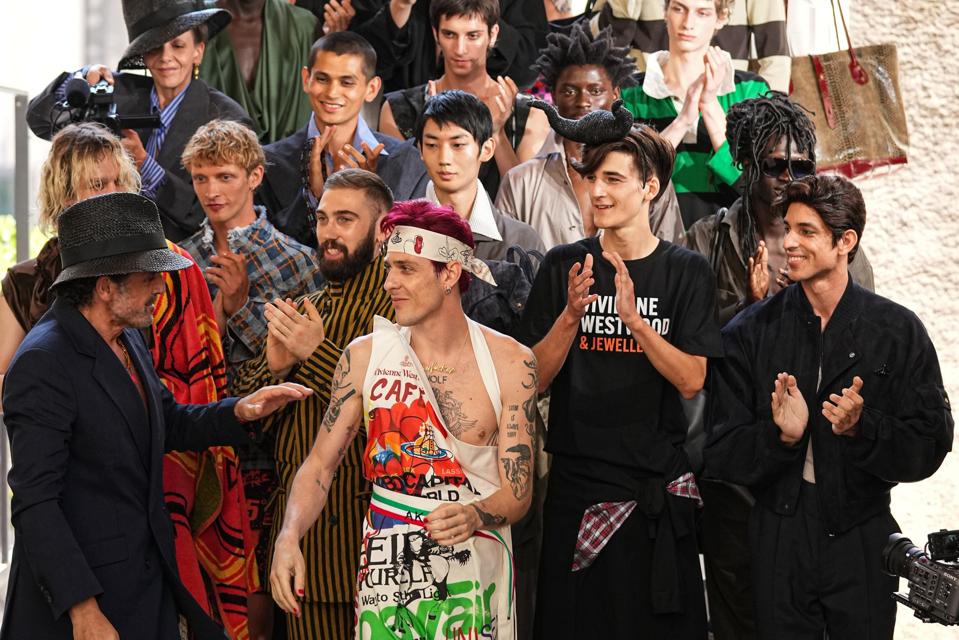
MILAN, ITALY – JUNE 22: Andreas Kronthaler and all the models attend the Vivienne Westwood … More
When Vivienne Westwood unveiled its latest dedicated menswear in a caffè in Milan, it felt less like a runway show and more like an intimate cultural reset — not just for fashion week but the world of fashion at large.
The choice of a caffè was unpretentious, warm, alive with possibility. A place where ideas are exchanged over espresso and where vulnerability felt welcome. Where Westwood’s Spring/Summer 2026 collection, Colazione Da Andreas, could easily unfold under the “Dandy Meets Granny” theme.
You heard that right—Dandy Meets Granny.
Masculine silhouettes softened with lace, baroque florals on sharply tailored suits, pearls defying combat boots — a visual dialogue of contradictions that felt both timely and timeless.
But beyond the aesthetic, the brand DNA set the disruptive and some would say “rebellious” tone. A complete absence of ego (well, ego in the negative sense anyway.) In the world of fashion — often dominated by personality cults and towering egos — this brand was all about ideas not egos. Collaboration not cut-throat.
It was so refreshing to experience — the ultimate, elevated brand experience. And I have no doubt it was a glimpse into the future of fashion culture across the board. Accessible. Achieveable. Inspiring. Inviting. Aspiring. Oozing attitude — but in the right way.
So what can we learn from the show that I believe stole the limelight at Milan Men’s Fashion Week?
The Caffè: A Symbol of Unscripted Disruption
MILAN, ITALY – JUNE 22: A model walks the runway at the Vivienne Westwood presentation during Milan … More
The café wasn’t just a venue — it was a symbol of the brand and immersive experience. A place where high culture collides with everyday life, where surprise is more important than perfection, where rebellion feels accidental rather than staged. And where you are genuinely invited into the world of Vivienne Westwood.
It felt like a bit of a throwback to what I imagine were the early days of the brand on King’s Road, when Vivienne Westwood and Malcolm McLaren shaped a punk aesthetic that would inspire generations with a Milanese twist. From the Sex Pistols to today’s global designer pieces, Westwood has always blurred the line between fashion collections and cultural movements.
Punk rock group “Sex Pistols” manager Malcolm McLaren and friend designer Viviane Westwood seen here … More
After the show, Andreas Kronthaler, Vivienne Westwood’s part owner and creative genius and — dare I say vulnerable — architect behind this collection and behind the brand for quite some years now, told me how he didn’t like the term “rebellious.” Rebellion, he explained, implies a deliberate, strategic act of defiance whereas his creative process isn’t about staging battles, it’s about openness to accidents that give birth to genuine expression.
MALDIVES – NOVEMBER 2: (UK TABLOID NEWSPAPERS AND MAGAZINES OUT) Vivienne Westwood and Andreas … More
Andreas is neither a commander obsessed with breaking rules nor is he a designer interested in shock value. He’s a leader who reveals rather than performs, who invites rather than dictates. And in a world that seems to be increasingly lacking kindness and connection, the concept of the power of vulnerability, I believe is only gaining greater momentum.
In fact, research published in Harvard Business Review shows that leaders who openly express uncertainty and reveal imperfections foster greater trust, loyalty, and emotional connection with their audiences and teams. Rather than undermining authority, this openness is seen as a sign of strength and courage, encouraging authenticity and deeper engagement.
The Celebration of Contradiction
“Dandy Meets Granny” embodied contradiction at its most compelling. Masculinity and femininity, the past and the future, softness and sharpness — all collided in a way that felt deeply human. And for those of you who have read The Kim Kardashian Principle, I emphasize the power of contradiction in branding. It’s definitely a counter-intuitive approach but, Westwood’s legacy — from sterling silver orb necklaces to her bridal collection reinterpretations — has often been about holding tension and turning it into art. It’s the same ethos that has earned her pieces a place at the Metropolitan Museum of Art and inspired designers from Rei Kawakubo to pioneering supermodels like the first British Black supermodel to front British Vogue, Naomi Campbell or even Kate Moss.
MILAN, ITALY – JUNE 22: A model walks the runway at the Vivienne Westwood presentation during Milan … More
At a time when some brands are still performing inclusivity and authenticity as carefully scripted acts, Vivienne Westwood’s approach felt like an invitation to breathe. There was no posturing for the algorithm, no orchestrated controversy. And while I talk alot about brands releasing societal tension to gain cultural relevance, it also reminded me that brands don’t have to resolve tensions to be loved. In fact, audiences today can crave complexity and the freedom to hold multiple truths at once. I’ve said it before and I’ll say it again Gen Z want to know what’s really going on behind the scenes so they can connect with brands on a values level.
Recent research confirms that audiences increasingly crave transparent and multi-dimensional brand narratives. One survey reports that 82% of Gen Z say they trust a company more when real customers appear in its marketing, while 72% are likelier to buy from brands supporting social causes. The much loved Edelman trust barometer reveals that 81% say trust influences their purchasing decisions. Additionally, a Stackla report reveals that 86% of consumers consider authenticity a key factor in choosing brands.
Bottom line? Dropping the performative act of inclusivity—eschewing staged controversy or algorithm-driven campaigns—allows brands to “invite rather than dictate,” fostering deeper connection by embracing complexity and revealing who they truly are.
The New Masculinity: Fluid, Playful, Free
For a new generation increasingly unwilling to accept binary definitions, Vivienne Westwood’s collection doesn’t shock; it liberates. Rather than trying to predict trends, I’d say it offers an entirely new narrative — one rooted in curiosity, self-expression, and a refusal to simplify.
MILAN, ITALY – JUNE 22: A model walks the runway at the Vivienne Westwood presentation during Milan … More
Much like Vivienne’s iconic Harris Tweed reinterpretations — designing bondage trousers made from the fabric for her Worlds End boutique — or her controversial takes on traditional punk hardware, this collection encouraged exploration over conformity. And as I’ve said for a while, I predict this exploration will ultimately see the merging of men and women’s fashion week.
Lesson for leaders? Brands chasing relevance through surveys and hashtags might consider what it means to better listen instead of react, to explore instead of control.
Take for example one survey that found that 50% of Gen Z and 56% of Millennials view traditional gender roles as outdated, and 52% agree gender isn’t binary. Another study of over 4,600 university students across the U.S., U.K., and Australia reported — “We are no longer this or that. We are this AND that.” Gen Z is actively rejecting rigid labels, favoring fashion that allows freedom and curiosity.
These findings affirm that when brands — much like Andreas Kronthaler’s work — offer narratives rooted in exploration instead of conformity, they resonate more deeply, because audiences crave complexity and the freedom to hold multiple truths simultaneously.
Invitation Over Instruction: A New Blueprint for Brand Leadership
The return of Vivienne Westwood to Milan Men’s Fashion Week after a decade and amidst the scent of espresso at Caffè Rivoli, one truth became clear: the future belongs to leaders willing to exchange ego for ideas, and presence for performance.
True innovation stems from openness, not orchestration. Audiences today crave brands that prioritize substance over self-importance, and complexity and contradiction can be the very foundation of authenticity and connection.
LONDON, ENGLAND – FEBRUARY 14: Dame Vivienne Westwood attends the Vivienne Westwood AW20/21 … More
I agree with Andreas, I don’t believe Vivienne Westwood’s collection was about rebellion in the traditional sense. To me, it was about revealing something honest and unguarded — and in doing so, reminding us that the most powerful statements aren’t shouted; they’re shared.
Because in a market oversaturated with noise — from New York City flagships to global boutiques on Davies Street and Melrose Avenue — I believe the boldest move isn’t to provoke; it’s to reveal. That’s how savvy audiences today will judge you, connect with you, and ultimately decide if you are worthy of their loyalty.
So let me leave you with this: the brands — and leaders — who will define tomorrow won’t be the loudest, the slickest, or the most meticulously crafted. They’ll be the ones daring enough to strip off the mask and show us exactly who they are — contradictions, imperfections, and all.
Named Esquire’s Influencer of the Year, Jeetendr Sehdev is a media personality and leading voice in fashion, entertainment, and influence, and author of the New York Times bestselling phenomenon The Kim Kardashian Principle: Why Shameless Sells (and How to Do It Right).
link