When 18th-Century Men Abandoned Exuberant Clothing for Sobriety

If you look closely, throughout history men have dressed almost the same as women in terms of variety of garments, color, and sophistication. It’s only recently that the two sexes have differed significantly, with women maintaining that richness and ornamental diversity, while men tend toward more homogeneous and chromatically subdued clothing—although this trend has somewhat softened lately. This is not a coincidence but rather a phenomenon that began in the second half of the 18th century, driven by the Enlightenment and consummated during the French Revolution: what is known as the Grande Renonciation Masculine, or Great Male Renunciation.
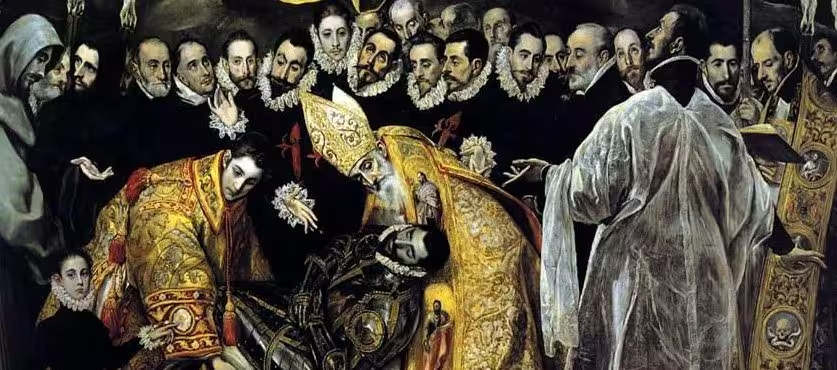
There have been occasional exceptions, such as the period coinciding with the height of the Spanish Empire—from the mid-16th century to the late 17th—when it was common for gentlemen to wear more sober clothing with a predominance of black in contrast to white ruffs, collars, and frilled neckwear.
However, this has often been misinterpreted, as it is frequently attributed to an obscurantist mindset imposed by Philip II, continuing until the Habsburgs were replaced by the Bourbons. In reality, it had a very different meaning: it was a fashion that Baldassare Castiglione wrote about in The Book of the Courtier, describing it as reflecting an image of seriousness, elegance, and sobriety, and it was driven by the Spanish monopoly on logwood.
As its name indicates, logwood (Haematoxylum campechianum) is a tree native to Mesoamerica—especially the Mexican state of the same name and Tabasco, in the Yucatán—from which a substance called hematoxylin is extracted. When oxidized, it produces a dark purple dye called hematein.
The Maya were already using it, and today it is typically used to stain organic tissues in histology labs, but back then it served to produce a black dye—“raven’s wing”—which became the quintessential color of elegant dress, a symbol of nobility that all European courts sought to imitate (the exploits of pirates and privateers targeted not only precious metals but also logwood), and which was complemented by the intense red derived from cochineal.
Could it be said, however, that this seemingly austere look was already pointing the way forward? In truth, it was not; as mentioned, it was a singular exception. While the Habsburgs and their grandees showed off their luxurious yet simple black garments, elsewhere—with the exception of Calvinist countries, where black suited their idea of austerity—the upper classes dressed and adorned themselves with multicolored floral extravagance, proudly flaunting their style; the same happened in Spain when Philip V took the throne and introduced French baroque fashion, breaking with the past, and that trend dominated the Western world until the mid-18th century, when the Enlightenment began to challenge all established ideas—hence it is known as the Century of Light or of Reason, concepts that must be understood in context.
Since Antiquity, clothing had been a marker of socio-economic status, revealing an individual’s place in society, to the point that laws were historically enacted ad hoc regulating what type of garments each class could wear, which fabrics were exclusive to the wealthy, whether one (or a woman) could adorn themselves with certain jewels, etc.
Isabella the Catholic enacted sumptuary laws, just as earlier in Republican Rome the Lex Oppia had done, Roman emperors reserved the color purple for their togas, and Byzantine rulers claimed the exclusive right to wear red boots, among other examples. The Enlightenment thinkers laid the groundwork to subvert all of that.
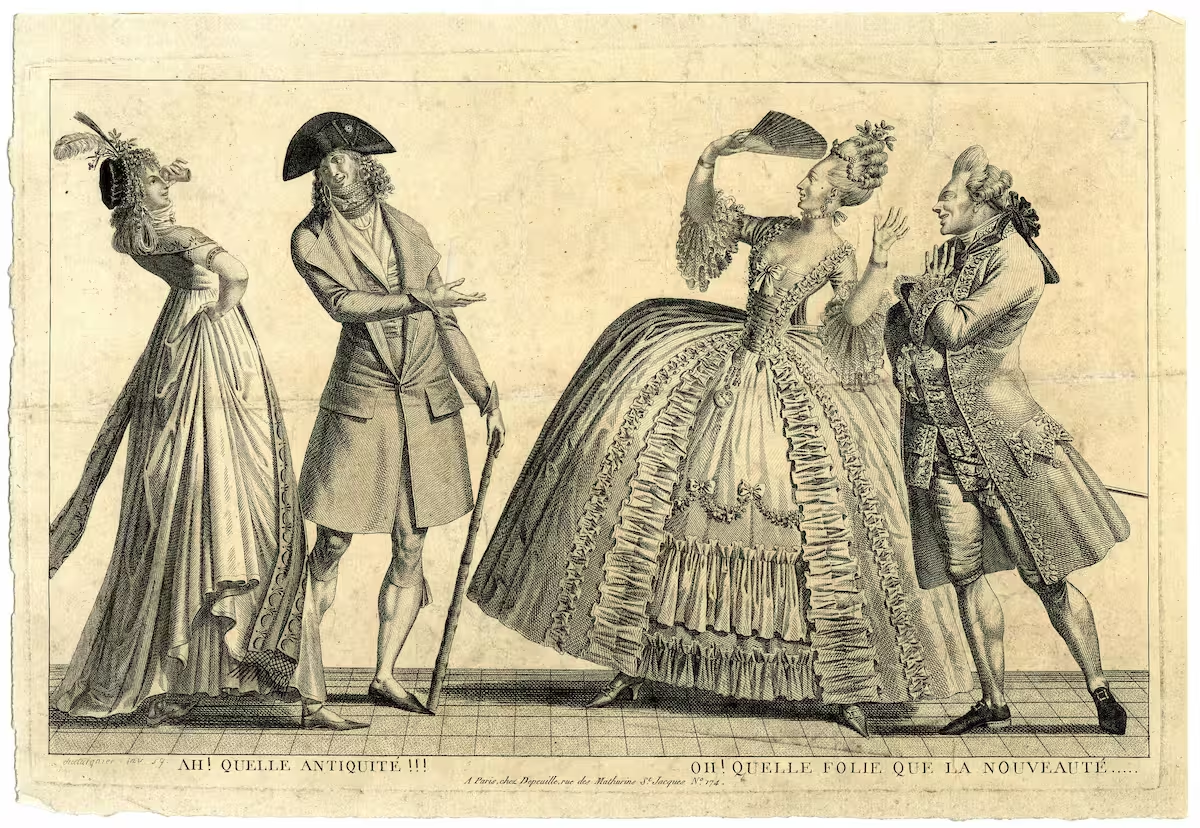
The estates gave way to egalitarianism, the monarchy no longer existed solely by the grace of God but also by the will of the people, and the slogan “Liberty, Equality, Fraternity” prevailed. The French Revolution embodied all of this, and one of its manifestations was in clothing. Wearing a tricorn hat, coat, tight breeches with silk stockings, and powdered wig became associated with the Ancien Régime, and instead, the Phrygian cap, the carmagnole (a short jacket that gave its name to an anthem), and the wide trousers worn by the working class—whose members, mostly revolutionaries, came to be nicknamed sans-culottes (“without culotte”) for that reason—began to take hold.
Apparently, the person who introduced the expression sans-culotte was Jean-Bernard Gauthier de Murnan, a soldier who had served in the Continental Army during the American War of Independence and later fought alongside Washington against the Six Indian Nations, before returning to France and becoming involved in the revolution, during which the Jacobins arrested him several times while they were in power during the period known as the Terror.
The new clothing represented the revolutionary’s resolve, freed from the rigidity of the aristocrat. However, the Enlightenment thinkers had already initiated a campaign in favor of comfortable and practical clothing for men, opposing them to women because they considered men more rational, whereas women were seen as prisoners of their emotions.
The Enlightenment was a phenomenon that sooner or later affected all Western countries, so the idea of dressing in a functional, modern way was not limited to France. During the American Revolution, since we’ve mentioned it, it caused a stir to see Benjamin Franklin doing without the characteristic white wig, which had replaced the long wigs introduced by Louis XIII. It was an accessory worn by every self-respecting gentleman in the eighteenth century and persisted—though increasingly out of use—well into the nineteenth century. In the U.S., it finally disappeared in 1840 thanks to a humorous speech delivered by Whig politician Charles Ogle against President Martin Van Buren.
Van Buren, a Democrat, had a well-earned reputation for being a dandy, something that was frowned upon after the economic crisis of 1837. The renovation he carried out on the White House, for which Congress had allocated a generous budget, sparked criticism, and Ogle delivered a mocking address in the House of Representatives against the president, in favor of the Whig candidate William Henry Harrison. Some attendees walked out, including members of his own party who were embarrassed, but most laughed and applauded the mockery, which later spread widely because Ogle printed and distributed tens of thousands of pamphlets.
What became known as the Golden Spoon Speech (alluding to the expression “born with a silver spoon in his mouth,” a synonym for wealth), made a mockery of the outdated fashion to which Van Buren clung—who, on top of that, lost the presidential election to Williamson—bringing it to an end.
In many other places, the same had already happened, although some stubborn elders persisted in clinging to the past by wearing a pigtail, and were thus seen as a kind of living fossil: such was the case of Spanish General Francisco Ramón de Eguía, a staunch traditionalist nicknamed Coletilla, as Galdós recalls in Los Cien Mil Hijos de San Luis (Episodios Nacionales), because he wore it until his death in 1827.
In short, the colorful and flamboyant male fashion disappeared for good, giving way to darker-toned clothing. Frock coats replaced waistcoats, and top hats took the place of tricornes, even in the military. High heels, which men had also worn—see, for example, portraits of Louis XIV—were greatly reduced.
Expensive fabrics were replaced by more affordable ones. And culottes gave way to long pants, the so-called “stovepipe trousers” invented by another dandy, the Englishman Beau Brummell, who also introduced the use of tall boots (and daily bathing), proposing a style consistent with temperance and modesty, which he considered traditional values of his country in opposition to extravagance.
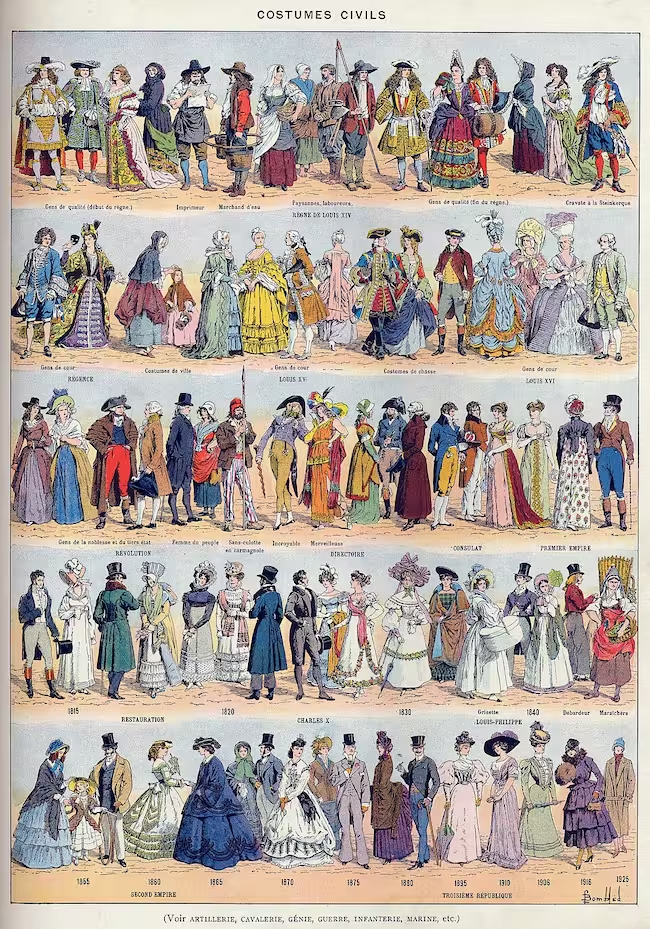
And so things continued throughout the nineteenth century and much of the twentieth. Only two periods of opposite character arose. One, limited to youth, during the Romantic era (roughly between 1800 and 1850, depending on the country), when some wealthy and arrogant young men, obsessed with being on the cutting edge, began wearing flashy colors, huge hats, and frock coats with large cuffs, frills, and often an intense green hue that led to them being called lechuguinos in Spain (or pollos; if they were only middle class, cursis). The other came in the 1960s, with the rise of counterculture, psychedelia, and the hippie movement, which diversified and made clothing more informal.
Finally, if anyone is wondering who coined the refined expression Great Male Renunciation, they should know it wasn’t a historian or a designer but an experimental psychologist and psychoanalyst named John Carl Flügel. A native of Liverpool, where he was born in 1884, he became interested in male behavior from his particular perspective in books such as Men and Their Motives and Man, Morals, and Society, but he addressed the issue of fashion in The Psychology of Clothes, published in 1930, where he explained: “Man abandoned his claim to be considered beautiful. From then onward, he aimed only to be useful. Insofar as clothing remained important to him, his greatest efforts could be directed only toward being ‘properly dressed,’ not elegantly or elaborately so.”
Flügel’s theory about this ideological-aesthetic shift, according to which men’s clothing set aside color and profuse ornamentation to focus on simplicity of fabrics and quality tailoring, has been criticized by Christopher Breward, a historian specializing in fashion.
He argues that it is excessively categorical and that, in reality, men continued to use a fairly wide range of colors—sometimes as striking as electric blue, the aforementioned green, or plaids—and did not give up their interest in clothing but rather transformed into more discreet consumers, taking a back seat to female consumption, which remained more ostentatious.
This article was first published on our Spanish Edition on August 1, 2025: La Gran Renuncia Masculina, cuando los hombres del siglo XVIII abandonaron el vestuario exuberante y optaron por la sobriedad
Discover more from LBV Magazine English Edition
Subscribe to get the latest posts sent to your email.

A team of archaeologists from the University of Copenhagen has found that in Murayghat, Jordan, a fascinating Early Bronze Age site (approximately 5,000 years ago), human groups gathered to honor…

Although the mechanism by which lightning strikes the ground has long been understood, the exact process that triggers its formation within storm clouds had remained one of the great mysteries…

In recent weeks, archaeologists working in the ancient Roman city of Suasa, located in the province of Ancona (Italy), have uncovered an extensive productive district that stretched along its main…

Beneath what will soon be the route of the SuedOstLink, an electric interconnection project in eastern Germany, archaeologists from the Landesamt für Denkmalpflege und Archäologie Sachsen-Anhalt have unearthed a set…

For over half a century, an archaeological mystery remained unsolved: what substance was hidden in those ancient bronze jars discovered in an underground Greek sanctuary in Paestum, in southern Italy?…

He spoke to me in the language used throughout all of Barbary and even in Constantinople among captives and Moors—a language that is neither Moorish, nor Castilian, nor of any…

An international team of researchers has identified what could be the first artificial memory systems created by humans, carved into bones tens of thousands of years ago. These findings, published…

Researchers from the University of Cambridge have uncovered an intact handprint in an ancient Egyptian tomb, a tangible remnant of the artisan who worked the clay four millennia ago. The…

An interdisciplinary team of archaeologists from Inrap and the Maison des Sciences de l’Homme of Clermont-Ferrand has concluded the 2025 excavation campaign in the Quartier des artisans (Craftsmen’s Quarter) of…

A recent study published in the Journal of Archaeological Science: Reports reveals fascinating details about the daily life of the inhabitants of Dispilio, a Neolithic settlement located on the shores…
Something went wrong. Please refresh the page and/or try again.
link