Why Korea’s flight attendants commute in uniform

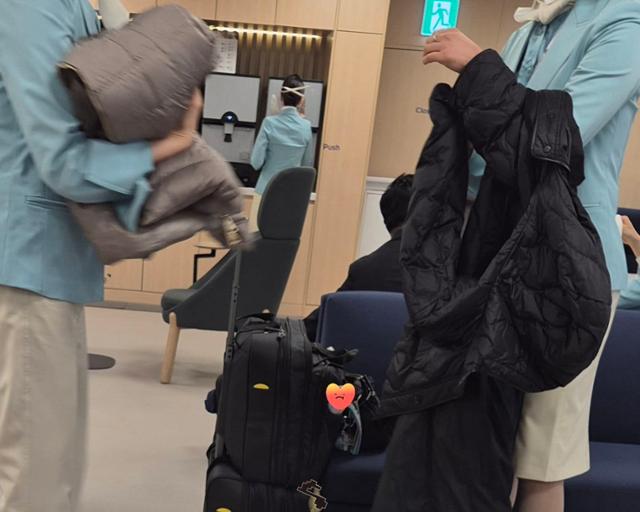
Flight attendants remove winter jackets before work on Jan. 14, amid freezing weather. Courtesy of Kwon Soo-jung, head of Asiana Airlines union
At first glance, Korea’s Incheon International Airport appears every bit the image of global glamour. Trains to the airport, which serves more than 70 million passengers a year, are filled with travelers — and with flight attendants commuting to work in full uniform.
Even in freezing weather, they can be seen wearing thin jackets and low shoes that leave their ankles exposed. The sight has become a familiar part of the airport’s daily rhythm.
Behind the scenes, however, lies a less visible reality. Many of these flight attendants are not choosing to commute in uniform, but are forced to — because their employers do not provide facilities like changing rooms.
According to an aviation industry worker, the reason flight attendants report to work in thin uniforms that are not warm enough for the cold weather is simple: Airlines do not provide adequate changing rooms or lockers.
The practice is not limited to low-cost carriers. Even Korean Air, a full-service airline that markets itself as a global carrier, requires flight attendants to arrive at work already in uniform or to change clothes in restrooms, workers said.
Until recently, Asiana Airlines had been an exception, providing flight attendants with personal lockers and coat hangers. After its merger with Korean Air, however, those facilities were eliminated.
Kwon Soo-jung, head of the Asiana Airlines labor union, said the facilities disappeared when the airline relocated from Terminal 1 to Terminal 2 at Incheon International Airport. She said it was example of the company paying little attention to the working environment of cabin crew.
“Nurses do not commute wearing uniforms, and firefighters do not come to work in protective gear,” she said. “Every workplace — hospitals, fire stations, factories — provides space to change into work clothes and lockers to store personal items. That is the employer’s basic responsibility.”
The airlines, however, do not share the same sense of urgency. Asked why changing rooms are not provided, Korean Air said such facilities “were never in place to begin with.”
Asiana Airlines cited space constraints at Terminal 2, saying priority was given to “essential facilities.” The airline added that it does not require flight attendants to commute in uniform and that storage bags are provided if needed.
The union disputes that explanation. Without changing rooms, wearing the uniform from home becomes a de facto requirement, according to the union.
Workers argue the issue extends beyond employee welfare and directly affects job performance, with potential implications for passenger safety.
“If cabin crew arrives drained from shivering through the commute, can they really fully protect passengers’ safety in case of emergency?” asked Kwon. “Installing small changing space is not a welfare perk — it is directly related linked to industrial safety.”
Labor experts agree that existing regulations leave a gap. Under current occupational safety act, employers are required to install changing facilities only for workers engaged in hazardous tasks. Yoon Ji-young, head of civic group Workplace Bullying 119, says that standard is too narrow.
“When uniforms are mandatory for the job, workers should be guaranteed a place to change,” Yoon said. “If there are gaps in the law or institutional framework, they must be addressed and corrected.”

Kwon Soo-jung, head of the Asiana Airlines union, wears a pants uniform. Captured from Kwon’s social media
When wearing pants was a protest
The dispute fits into a longer history of battles over cabin crew working conditions. It was only in 2014 that female flight attendants won the right to wear pants instead of skirts, after years of protest that eventually reached the National Human Rights Commission.
Kwon led the movement and became the first female attendant at Asiana Airlines to board a flight wearing pants in January of that year.
“The answer is simple,” she said when asked why she spearheaded the campaign. “Clothing should be safe and practical for work.” Emergency evacuations and security duties, she argued, require functional attire rather than uniforms designed primarily for appearance.
After a three-year struggle, the policy was changed. Kwon said the lesson should not be forgotten. “Workers must not be treated like cargo again,” she said. “Airlines should immediately provide sufficient space for flight attendants to change clothes and store their belongings.”
This article from the Hankook Ilbo, the sister publication of The Korea Times, is translated by a generative AI system and edited by The Korea Times.
link